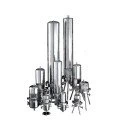
Hey there! As a supplier of Industrial Dust Filters, I've seen firsthand the importance of understanding the differences between surface and depth filtration in the industrial world. Let's dive right in and explore these two filtration methods.
Surface Filtration
Surface filtration is like a bouncer at a club. It's all about keeping the big guys out at the entrance. In this case, the "big guys" are the dust particles. When using a surface filter, the dust particles are captured on the surface of the filter media.
The key characteristic of surface filtration is that it forms a dust cake on the surface of the filter. This dust cake actually helps in the filtration process by acting as an additional layer of filtration. As more dust accumulates, the cake becomes thicker, and the filtration efficiency increases. However, this also means that the pressure drop across the filter increases over time.
One of the main advantages of surface filtration is its high efficiency in capturing large particles. It can remove up to 99% of particles larger than a certain size, depending on the filter media. This makes it ideal for applications where the dust contains a significant amount of large particles.
Another benefit is that it's relatively easy to clean. Since the dust is mainly on the surface, a simple reverse air pulse or shaking can dislodge the dust cake, allowing the filter to be reused.
For example, in a woodworking shop, where there are a lot of large wood chips and sawdust, a surface filter like the Shop Vac Fine Dust Filter can do a great job. It will capture the large particles on the surface, and with regular cleaning, it can maintain its performance for a long time.
However, surface filtration also has its limitations. It's not very effective in capturing small particles. The small particles can easily pass through the gaps in the dust cake or the filter media. Also, if the dust is very sticky or cohesive, it can be difficult to remove the dust cake completely, which can lead to a decrease in filtration efficiency.
Depth Filtration
Depth filtration is more like a maze. Instead of just keeping the particles out at the surface, it traps them inside the filter media as they pass through. The filter media in depth filtration is usually a thick, porous material with multiple layers.
As the dust particles travel through the filter, they get trapped in the pores and fibers of the media. This means that depth filtration can capture both large and small particles. It's especially effective in capturing small particles that might pass through a surface filter.
One of the advantages of depth filtration is its high dirt-holding capacity. Since the particles are distributed throughout the filter media, it can hold a large amount of dust before it needs to be replaced. This makes it suitable for applications where the dust load is high and continuous.
Another benefit is that it can provide a more consistent filtration efficiency over time. Unlike surface filtration, where the efficiency can change as the dust cake forms and is removed, depth filtration maintains a relatively stable performance as long as there is still available pore space in the media.
For instance, in a chemical processing plant, where there are fine dust particles and a high dust load, a depth filter such as our Industrial Dust Filter can be a great choice. It will trap the fine particles inside the media and can handle the continuous dust generation.
However, depth filtration also has its drawbacks. It's more difficult to clean compared to surface filtration. Since the dust is trapped inside the media, it's not as easy to remove it completely. Usually, a more complex cleaning method, such as backwashing or ultrasonic cleaning, is required.
Also, the initial pressure drop across a depth filter is higher than that of a surface filter. This means that more energy is required to push the air through the filter, which can increase the operating cost.
Comparing the Two
Now, let's compare surface and depth filtration in some key aspects:


Filtration Efficiency
As mentioned earlier, surface filtration is very efficient in capturing large particles, while depth filtration can capture both large and small particles. So, if your application mainly involves large particles, surface filtration might be the better choice. But if you need to capture a wide range of particle sizes, especially small ones, depth filtration is more suitable.
Cleaning and Maintenance
Surface filtration is generally easier to clean. A simple reverse air pulse or shaking can often do the job. Depth filtration, on the other hand, requires more complex cleaning methods. This means that the maintenance cost and downtime for depth filtration can be higher.
Dirt-Holding Capacity
Depth filtration has a higher dirt-holding capacity because the dust is distributed throughout the filter media. Surface filtration, with its dust cake formation, has a more limited dirt-holding capacity, especially if the dust cake is not removed regularly.
Pressure Drop
The initial pressure drop in surface filtration is relatively low, but it increases as the dust cake forms. In depth filtration, the initial pressure drop is higher, but it remains relatively stable as long as there is available pore space.
Cost
The cost of surface filters is usually lower than that of depth filters. However, when considering the overall cost, you also need to take into account the cleaning and replacement frequency, as well as the energy consumption due to the pressure drop.
Applications
Let's take a look at some common applications and which type of filtration is more suitable:
Woodworking
As mentioned before, surface filtration is a good choice for woodworking shops. The large wood chips and sawdust can be easily captured on the surface of the filter, and regular cleaning can keep the filter working effectively. You can use a Shop Vac Fine Dust Filter for this application.
Metalworking
In metalworking, there are usually a mix of large metal shavings and fine metal dust. A combination of surface and depth filtration might be the best solution. The surface filter can capture the large shavings, while the depth filter can handle the fine dust. Our Dust Collector Cartridge Filter can be a great option for this application.
Pharmaceutical and Food Processing
In these industries, the requirements for air quality are very high. Depth filtration is often preferred because it can capture small particles and ensure a high level of filtration efficiency. It can help prevent contamination and maintain the quality of the products.
Making the Right Choice
When choosing between surface and depth filtration, you need to consider several factors:
- Particle Size Distribution: Analyze the size of the dust particles in your application. If there are mainly large particles, surface filtration might be sufficient. If there are a lot of small particles, depth filtration is a better choice.
- Dust Load: If the dust load is high and continuous, depth filtration with its high dirt-holding capacity might be more suitable. If the dust load is relatively low, surface filtration can work well.
- Cleaning and Maintenance: Consider your ability to clean and maintain the filters. If you have limited resources for cleaning, surface filtration might be easier to manage.
- Cost: Look at the initial cost of the filters, as well as the long-term cost of cleaning, replacement, and energy consumption.
Conclusion
In conclusion, both surface and depth filtration have their own advantages and disadvantages. As a supplier of Industrial Dust Filter, we understand that choosing the right filtration method is crucial for the performance and efficiency of your dust collection system.
If you're still not sure which type of filter is best for your application, don't hesitate to reach out to us. We have a team of experts who can help you analyze your needs and recommend the most suitable solution. Whether you need a surface filter or a depth filter, we can provide high-quality products and excellent service.
So, if you're interested in purchasing industrial dust filters or have any questions about surface and depth filtration, feel free to contact us for a procurement discussion. We're here to help you make the right choice and ensure the success of your industrial operations.
References
- Brown, R. C. (2000). Introduction to Air Pollution Control. New York: Wiley-Interscience.
- Hinds, W. C. (1999). Aerosol Technology: Properties, Behavior, and Measurement of Airborne Particles. New York: Wiley.
- Perry, R. H., & Green, D. W. (1997). Perry's Chemical Engineers' Handbook. New York: McGraw-Hill.