


Desiccant Air Dryer
What is Desiccant Air Dryer
A desiccant dryer or an adsorption dryer is a piece of industrial equipment that uses desiccant materials to eliminate water from the air channeled through it. A standard desiccant dryer system uses a two-tower setup to ensure a continuous air-drying cycle. A desiccant air dryer for compressed air uses special drying agent beads like silica gel and activated alumina to absorb water vapor from an air stream. These air dryer units are often regenerative so that the drying agent doesn't need replacing in order to provide vapor-free compressed air consistently.
Advantages of Desiccant Air Dryer
Ncreased moisture removal
Desiccant air dryers are designed to remove moisture from compressed air. By removing the moisture, these dryers help prevent the formation of condensate, which can cause corrosion and damage to equipment.
Improved product quality
Moisture in compressed air can lead to product contamination, spoilage, or defects in industrial processes. Desiccant air dryers ensure dry and clean air, thereby improving the quality and consistency of the end products.
Increased efficiency
Dry air provided by desiccant air dryers allows pneumatic equipment, tools, and machinery to operate at maximum efficiency. Dry air reduces friction, wear and tear, and the risk of malfunctions, leading to lower maintenance costs and increased equipment lifespan.
Enhanced performance
Some industrial applications require low dew point levels of compressed air. Desiccant air dryers can achieve extremely low dew points, ensuring that the air meets the required specifications and supports the optimal performance of sensitive instruments and processes.


Why Choose Us
Our Factory
In 2016,the company formally moved in to Renhe advanced manufacturing base in Yuhang District. The newly moved office area is spacious and bright with complete equipped facilities, which will greatly improve the office environment and work efficiency of all employees, create a good service environment for customers and enhance the company image.
Product Application
The products are widely used in electric power, shipbuilding, aerospace, electronics, metallurgy, machinery, automobile manufacturing, petroleum, chemical industry, textile, chemical fiber, light industry, paper-making, rubber, instrumentation, food, air separation, cigarette, medicine, biology, daily chemicals and other industries.
Production Market
We are sold well in more than 30 provinces and cities in China, and nearly 10000 users have played an active role in national key projects. The products have been exported to Pakistan in complete sets for many times West, Australia, Iran, India, Sudan, Indonesia, Vietnam, Saudi Arabia and other Southeast Asia, the Middle East, Central Asia and Africa.
Our Service
Strong and perfect after-sales service network, there are 9 customer service centers in major regions of China, each center has professional service engineers, a total of more than 50 people, quickly and timely solve problems in after-sales service, such as equipment start-up debugging and troubleshooting.
Types of Desiccant Air Dryers
Regenerative desiccant air dryers
A general term for dryers that utilize a desiccant material which attracts and holds moisture. The ‘regenerative’ part comes from the fact that the desiccant is regenerated, or dried out, for reuse. There are various types of regenerative desiccant dryers, including single tower, heatless, heated, and blower purge dryers . They’re typically used in applications requiring extremely dry air with a pressure dew point as low as -100℉.
Single tower desiccant dryer
Consists of a single tank filled with a desiccant that absorbs the moisture from the compressed air. However, it cannot regenerate the desiccant itself, so manual intervention is required.
Heatless twin-tower desiccant dryers
Operate on a dual-tower setup. While one tower dries the incoming air, the other regenerates the spent desiccant using a portion of the dried compressed air (purge air).
Heated blower purge desiccant dryers
Use an external heater and blower to generate hot air for desiccant regeneration, eliminating the need for purge air and making them more energy-efficient.
Heated desiccant dryers
Use external heat sources to regenerate the desiccant, reducing the amount of purge air required and improving efficiency.
Manual change desiccant pots
These are simple systems where the desiccant is manually replaced once it’s saturated. They’re typically used in small-scale applications.
Working Principle of Desiccant Air Dryer
Regenerative desiccant type dryers use a porous desiccant that adsorbs the moisture by collecting it in its myriad pores, allowing large quantities of water to be retained by a relatively small quantity of desiccant. Desiccant types include silica gel, activated alumina, and molecular sieves. In some cases, more than one desiccant type can be used for special drying applications. In most of these cases, a larger particle size (1/4” or more) is used as a buffer zone at the inlet, while a smaller particle size desiccant (1/8” to 1/4”) is used for final drying. Where very low dew points are required, molecular sieve desiccant is added as the final drying agent. The most common dew point rating for these dryers is -40. While this level may be needed for sensitive processes or instrumentation, this level of dryness in not normally needed in general manufacturing unless the pipes are exposed to freezing temperatures.
Normally the desiccant is contained in two separate towers. Compressed air to be dried flows through one tower, while the desiccant in the other is being regenerated . Regeneration is accomplished by reducing the pressure in the tower and passing purge air through the desiccant bed. The purge air may also be heated, either within the dryer or externally, to reduce the amount of purge air required. Heated purge air may also be supplied by a blower. Desiccant dryers all have a built-in regeneration cycle, which can be based upon time, dew point, bed moisture load or a combination of these.
All of these dryers have filtration on the inlet to keep water and oil from damaging and contaminating the desiccant. An additional filter on the outlet catches the desiccant dust that is generated from the constant movement of the desiccant beads against one another caused by flow of air through the dryer.
How to Improve the Efficiency of the Desiccant Air Dryer
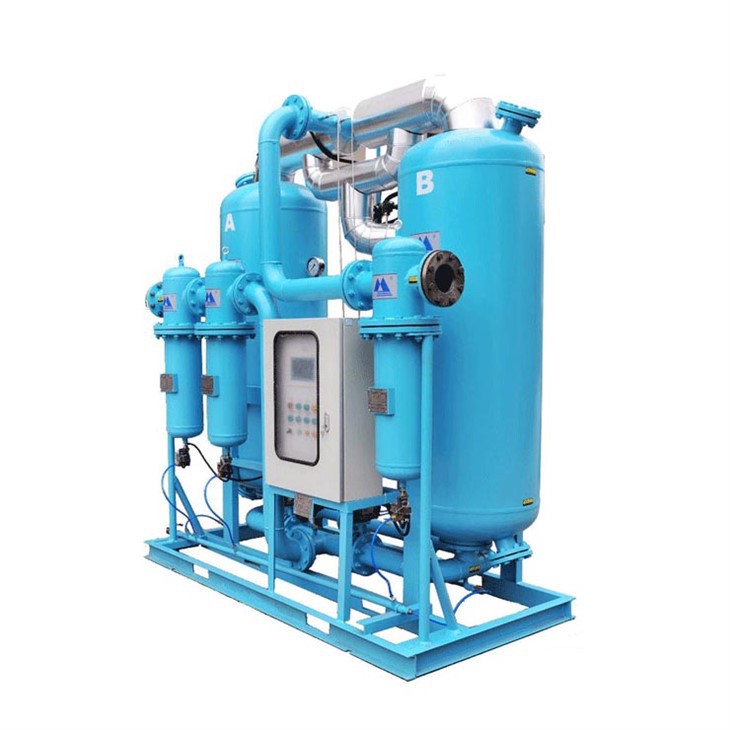


Desiccant air dryers can operate more efficiently by applying dew-point controls. Often, dew-point controls are already installed on a dryer, but nobody has thought to use them. These controls, through various methods, turn off the purge flow on the regenerating side once the desiccant has been fully reactivated, saving compressed air that would otherwise be wasted because of dryer partial loading. The switching of the dryer towers is delayed until the control senses when the desiccant has reached the point of saturation (or when a maximum period of time has elapsed in some dryers).
Right-size your dryers– A very large dryer can affect system efficiency if not properly controlled. However, care should be taken to ensure that dryers are sized for worst-case conditions; this often requires dryers to be sized larger than the capacity of the connected compressors.
Calibrate dew-point controls– The dew-point sensors in a controlled dryer can become contaminated or out of calibration, causing malfunction of the control. The reading should be compared with another calibrated independent meter on a regular basis.
Upgrade and maintain filters– Desiccant air dryers can often be purchased with dual inlet filters; if installed in parallel, they can reduce the pressure differential to one-quarter the normal level. Filters will cause excessive pressure differential if not maintained.
Be vigilant about keeping free water out– Free water must not be allowed to enter the dryers. Small wet receivers or some sort of separator rated for water removal should be installed directly ahead of the dryer.
Check purge adjustment– The purge flow can become out of adjustment during the life of a dryer. Check this adjustment regularly.
Maintain purge mufflers– Plugged purge exhaust mufflers restrict the flow and can cause incomplete desiccant regeneration.
Maintain switching valves– Switching-valve failure causing valve leakage can allow wet air to enter the dryer from the active side. This causes the dryer to consume much more purge than normal and results in incomplete regeneration. On lightly loaded dryers, this condition can go undetected for long periods of time.
Turn off the cooling purge– Some heated blower dryer makes and models allow turning off the cooling purge under certain conditions where short dew-point spikes will not cause system problems.
Monitor dryer hours – Some dryer controls report the status of the dryer and the percentage savings. Keeping a log of these numbers and comparing them week to week can show whether something has gone wrong.

Plastic mold blowing. Drying of pellets prior to processing.
Electronics production: Printed Circuit Boards (PCB) and other electronic components. To avoid any moisture during production process as it could cause short circuit or oxidation.
Power plant: Compressed air is used to control actuators of different valves. If an actuator does not function this might lead to power plant shutdown. The better the air quality is, the more secure is the actuator operation.
Food & beverage manufacturing: In packing machines where air contacts direct the goods need to have a dewpoint at min -40℃ to combat the growth of micro-organisms.
Marine: Offshore or Onshore rigs. Production of N2 (-70℃ PDP) especially for ships who run with LNG. Outdoor piping should only carry dry air as otherwise humidity in the pipe will start freezing. Dry air is also required for aeration of cargo and fuel tanks prior to inspection and for critical control or instrument air applications.
Laser cutting: Dry air keeps the lenses clean and dry in order to have an optimized cutting result.
Purge is based on nameplate rating
It is important to realize that the purge rating of an uncontrolled desiccant dryer is based on nameplate rating, not the amount of air flowing through it. The purge control is often simply an orifice or cracked open valve of some sort that allows a fixed flow of air from the pressurized side to the side being regenerated. The flow of air is not affected by the amount of air being dried in the air dryer unless there is some sort of dew point or moisture control. A properly sized dryer will be oversized to compensate for worst case conditions where excessive ambient and inlet temperatures are experienced at full load. Typically the average loading of the dryers is not at worst case conditions, however, meaning a typical dryer will often be running at average flows that are lower than its nameplate rating.
Sometimes the purge continues when compressor is off
If the dryer is operating on a fixed cycle with no dew point control and the associated compressor turns off for some reason, which stops the flow of compressed air through the dryer, the purge will often continue to be fed from other system compressors. This flow allows the purge cycle to continue uninterrupted, but once the desiccant has been regenerated an uncontrolled dryer will continue to consume purge air for no reason and waste significant amounts of compressed air even though there is no air flowing through it. In this case the efficiency of the dryer is very poor. If multiple dryers exist in this condition during low load periods the waste can be extreme.
Air dryers are often the biggest use of compressed air
When auditing a compressed air system it is very common to find that uncontrolled desiccant dryers represent the biggest use of compressed air in the plant. This is especially true for lightly loaded systems where the compressor and dryer are much larger than the actual average loading due to size mismatch or load characteristics.
Purge flows can change
The adjustment of the purge flow in a dryer is important. Often this is a manual adjustment that is done during a specific part of the dryer cycle. Many times the adjustment is simply the position of a ball valve based on the pressure reading on a gauge. Over time the ball valve can become misadjusted and the gauge can go out of calibration. The purge exhaust ports can plug causing a back pressure that can reduce the purge flow. Poor adjustment can lead to purge flows that are much higher than the rating of the dryer. Since there is typically no way of directly measuring the purge flow this wasteful higher flow is rarely detected. Regular testing is a good practice.
Pressure effects purge
Due to numerous reasons some systems operate higher than 100 psi, sometimes much higher. If the dryer uses a fixed orifice, this higher pressure will cause the dryer to consume more that rated purge. Dryers running at higher pressures actually need less than rated purge. Manufacturers can supply proper orifices for various rated pressures to reduce this wasteful flow for pressures other than 100 psi thereby saving purge cost.
Check the check valves
Some dryer designs have integrated check valves internal to the dryer. When this check valve is located downstream of the point where the purge flow is redirected to the regenerating side the air from the plant cannot get back to the dryer to maintain purge flow if the associate compressor unloads. This can have energy savings benefit if the associated compressor turns off, however, because the associated compressor now must exclusively feed the dryer purge this can cause compressor control issues. Where the dryer has a check valve and there is no large storage receiver between the compressor and the dryer a load unload compressor will rapid cycle. As soon as the compressor tries to unload the dryer will rob the compressor of its control signal, the check valve preventing back flow, and the compressor will immediately have to load up again. This can continue with the compressor inefficiently rapidly loading and unloading, even when there is no real system load on the compressor.
Dewpoint controls save
One way to ensure the purge flow stays at near 15 to 20 % of the actual dryer flow is to use dew point or loading controls on the dryer. These controls adjust the purge time of the dryer to ensure that all the desiccant is saturated before the flow of purge starts to regenerate the desiccant. This method of control sometimes has its problems as the typical designs allow the desiccant to both sides to saturate fully before the flow of purge is turned on. Since both sides need regeneration there are sometimes a cluster of multiple purge cycles that can cause additional air demand.
Purgeless doesn't always mean purgeless
A big plus for heated blower style dryers is that they are purgeless dryers, they use heated ambient air to regenerate the desiccant, not expensive compressed air. But the desiccant in the dryer remains hot after the regeneration cycle, and hot desiccant does not dry the air. Since there isn't enough time to cool naturally in a standard four hour cycle, the desiccant is most often cooled using a flow of compressed air, not exactly purge, but a consumption of air just the same.
Temperature and flow effects
The temperature of the inlet air affects the moisture loading on desiccant air dryers. For every 20 degrees F drop in temperature the moisture content roughly reduces by half. Heatless desiccant air dryers are not affected by this reduction in moisture loading, so they don't save if the air temperatures are reduced. For very light loading this lack of moisture can actually cause heatless dryers to perform poorly. Heat regenerated dryers that are dew point controlled; on the other hand, reduce their purge flow in proportion to moisture loading.
Filter differential costs energy
Because the desiccant is sensitive to oil and free water contamination there is usually a series of filters on the inlet and outlet of these dryers. Typically a particulate and coalescing combination is placed on the inlet and particulate on the outlet. When auditing these dryers this is a location that represents typically one of the biggest pressure differentials in the whole system. Where 5 to 7 psi exists across the dryer filter combination about 2 to 3 percent more compressor power is required to overcome this resistance.
FAQ