


Combined Air Dryer
What is Combined Air Dryer
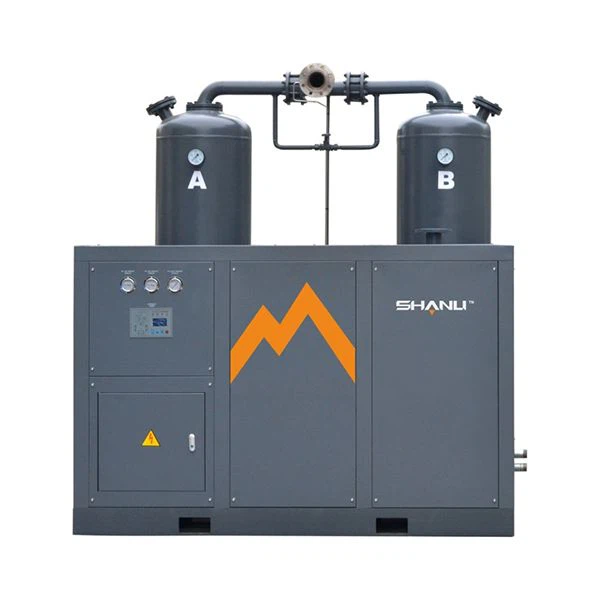
A combination air dryer consists of a refrigerated air dryer and a desiccant air dryer designed to dehumidify compressed air. Instead of being installed individually, they are assembled to be interacted with each other, enhancing product performances and reducing energy consumption.This high-efficiency, low-cost eco-friendly combination air dryer is designed to enhance dehumidifying performances and reduce energy consumption by supplying compressed air cooled by the refrigerated air dryer to the desiccant air dryer and reheat and supply the dehumidified compressed air.
Advantages of Combined Air Dryer
Flexibility
Combined air dryers can adjust their operating modes according to various application requirements, making them adaptable to different humidity levels in work environments.
Efficient dehumidification
By integrating refrigeration and adsorption technologies, combined air dryers effectively remove moisture from compressed air, ensuring the delivery of dry gas.
Reliability
Utilizing multiple technologies, combined air dryers are often more reliable than single-technology dryers. Even if one technology experiences a malfunction, the other can maintain drying performance.
Stability
Through the amalgamation of diverse technologies, combined air dryers provide more consistent output in terms of gas humidity and temperature, ensuring production stability in industrial processes.
Wide applicability
Compressed air combination air dryer are suitable for various industrial domains, including electronics manufacturing, food processing, pharmaceutical production, and more, meeting diverse requirements for dryness and gas purity.
Energy optimization
In certain scenarios, combined air dryers can better balance energy consumption, resulting in more efficient drying performance.


Why Choose Us
Our Factory
In 2016,the company formally moved in to Renhe advanced manufacturing base in Yuhang District. The newly moved office area is spacious and bright with complete equipped facilities, which will greatly improve the office environment and work efficiency of all employees, create a good service environment for customers and enhance the company image.
Product Application
The products are widely used in electric power, shipbuilding, aerospace, electronics, metallurgy, machinery, automobile manufacturing, petroleum, chemical industry, textile, chemical fiber, light industry, paper-making, rubber, instrumentation, food, air separation, cigarette, medicine, biology, daily chemicals and other industries.
Production Market
We are sold well in more than 30 provinces and cities in China, and nearly 10000 users have played an active role in national key projects. The products have been exported to Pakistan in complete sets for many times West, Australia, Iran, India, Sudan, Indonesia, Vietnam, Saudi Arabia and other Southeast Asia, the Middle East, Central Asia and Africa.
Our Service
Strong and perfect after-sales service network, there are 9 customer service centers in major regions of China, each center has professional service engineers, a total of more than 50 people, quickly and timely solve problems in after-sales service, such as equipment start-up debugging and troubleshooting.
Types Of Combined Air Dryer
In pneumatic systems, the process of compressing air leads to water vapour, which causes condensation due to the subsequent cooling downstream. Even the slightest amount of moisture in the system could cause corrosion and bacterial growth, which can make your processes sluggish or lead to the breakdown of equipment. The right combined air dryer will help keep moisture out and extend the life of your compressors.
Here's an overview of the four different types of combined air dryers
Refrigerated Air Dryers
They cool the compressed air to cause condensation and collect and drain the liquid water through an internal moisture separator, leaving the compressed air completely dry.
Refrigerated dryers come in two types:
Cycling Refrigerated Dryers: Feature intermittent runs with need-based power ups that economize electricity consumption and costs.
Non-cycling Refrigerated Dryers: Run continuously and maintain consistent dew points.
Due to their inexpensive setup, ease of maintenance, and resistance to airborne particles, refrigerated dryers are an excellent choice for several different industries. However, since they generate air pressure dew points between 35℉ and 40℉, refrigerated dryers may not be suitable for processes that require extremely dry air, or for circuits that see sub-freezing temperatures.
Desiccant Air Dryers
These dryers use desiccant agents to dry the compressed air in a process called adsorption (the moisture attaches itself to the desiccant without dissolving). To avoid desiccant saturation, they also include a regeneration process that ejects the accumulated moisture from the dryer. Desiccant dryers feature two variants:
Heated Desiccant Dryers: They redirect 8% of the dried air through a heater in the circuit to remove moisture from the desiccant before being discharged.
Heatless Desiccant Dryers: They divert 15% of the dried air to the regenerative tower, extract water off the desiccant, and subsequently discharge the moist air.
Desiccant air dryers maintain consistent dew points of -40℉or less. When paired with a regenerative desiccant at the point of use, they can reach dew points of -100°F. While these dryers are employable in remote or hazardous environments, their initial cost can be high, and the desiccant bed needs replacement every three to five years.
Chemical Air Dryers
Instead of a desiccant bed, the compressed air passes over a bed of moisture-absorbing chemicals, such as calcium chloride, sodium, or lithium. These dryers require a high-quality filtration system to dispose of the chemicals that attract and collect the moisture. Chemical dryers are inexpensive to install, easy to operate, and require minimal monitoring. However, their performance depends on the efficiency of the filtration systems. Additionally, disposal of saturated chemicals may be expensive or complicated, depending on the location and nature of your business.
Membrane Air Dryers
Used as dehumidifiers or for applications that need gas separation, membrane air dryers direct the compressed air across bundles of semi-permeable membrane fibres. These dryers are ideal for single points-of-use or smaller projects. While they are easy to operate and maintain and do not require electricity, they need a frequent change in the prefilter for effective functioning.
Selecting the Right Combined Air Dryer
Dryers remove moisture and humidity from compressed air. This makes them a crucial component of your air system. That's because air is completely saturated as it leaves your compressor. This moisture can cause contamination and corrosion that can affect your entire air system, your pneumatic tools and even your final products. Using compressed air dryers is imperative, especially in industries with stringent air quality requirements. Think food/beverage, electronics, manufacturing and automotive spray-painting.
Air and environmental factors
Air dryers are sized based on your ambient temperature and incoming air, as well as the capacity of your air compressor. The larger the power consumption of your compressor, the larger the flow the dryer must be able to handle. Most importantly, you want to choose the right dryer based on the temperature of your environment and the air quality needs of your application.
Dew point versus relative humidity
Some industries must adhere to stringent compressed air quality standards. They require air with a specific dew point. This is the temperature at which water vapor begins to condense into water. These high-quality air applications need the dew point of their compressed air to be low and - very importantly - to be stable. However, only those who use compressed air in these critical applications should use dew point. Companies that just want to prevent condensation of water in their pipelines and tools are well served with the term relative humidity. Since the ambient temperature over the year fluctuates, a constant relative humidity results in a fluctuating dew point. That would not be acceptable for critical applications, but it works just fine for those who only need condensation prevention. Either the risky conditions occur in the winter, which means that a higher PDP is okay in the summer. Or, if the sensitive time is in the summer, then a negative PDP is required in the winter. Note again that this only applies to condensation prevention.
Refrigeration dryers
Refrigeration dryers are your ideal solution if you meet the following criteria:
Your ambient temperature is less than 40°C/104°F
Your main goal is to prevent condensation
You need to achieve a dew point around 3°C-4°C/37°F-39°F
Refrigeration dryers use the same working principle as air conditioning units, cooling the air with a heat exchanger, a refrigerant circuit and a compressor. They come in both cycling and non-cycling variants to fit the need of your applications and operational preferences. Refrigeration dryers are very energy efficient, making them the most common dryer type.
Refrigeration dryers are often used in manufacturing plants, auto shops, food manufacturing, and breweries.
Adsorption dryers
If your ambient temperature and incoming air are over 40°C/104°F, typically a high-temp dryer is recommended. Installing an after cooler after the compressor is also advised.
If you need very dry air (PDP of -40°C/-40°F or -70°C/-94°F) an adsorption dryer is your best choice. Adsorption dryers can reach pressure dew points as low as -70°C/-94°F.
That makes adsorption dryers the ideal solution for very cold climates, as they can help avoid ice formation in pipes and applications. They are also widely used in applications such as mold prevention, medical applications, textiles, and food factories.
These dryers use desiccant material to adsorb and remove the humidity from compressed air. Adsorption dryers consist of two towers. While one tower is drying air, the other is removing the moisture from already saturated desiccant. This so-called regeneration process prepares the desiccant for a new drying cycle.
Adsorption dryers also come in different technologies such as heatless dryers, heated purge dryers or blower purge and zero purge dryers.
Importance of Combined Air Dryer
Removes Water Contamination
Water contamination is a serious problem in industries that use high purity compressed air such as laser cutting and welding, plasma generation, microelectronics production, food and pharmaceutical products manufacturing, shot blasting, painting, and coating. Water, along with other contaminants, can create various effects depending on how the compressed air is used. An example is laser cutting which uses air to cool the resonator—a component that generates high-intensity light beams. When water-contaminated air is used, cooling efficiency is decreased which results in overheating and loss of energy.
Prevents Water Buildup
Usually, compressed air is fully saturated with water. Decreasing its temperature or further compression and pressurization can cause the diffused water vapor to precipitate. When compressed air at this state is supplied to downstream equipment, there is a risk of water buildup in small cavities or depressions within the equipment. Water buildup can affect the operation of sensitive equipment such as measuring and monitoring devices.
Abates Corrosion
The presence of water into equipment internals can cause corrosion to steel surfaces. Pipe, tanks, vessels, drums, and mixing equipment internals can accumulate water from the condensation of saturated air. This can promote corrosion to the internal surfaces of equipment which may lead to product or process stream contamination.
Inhibits Microbial Growth
Compressed air is used in the food and beverage industry for product mixing and conveying. Water from a compressed air system can carry microbes that can result in food contamination and spoilage. Pharmaceutical manufacturing plants require air with more stringent qualities as small amounts of impurities can potentially ruin a whole batch of products.
Prevents Freezing
Precipitated water in compressed air systems can freeze. They can jam moving components of pneumatic actuators of valves and measuring devices. Freezing of accumulated water on process lines can disrupt product or process fluid flow.
Improves Efficiency of Air-Powered or Pneumatic Equipment
Air-powered tools and equipment use energy from compressed air for driving air motors or turbines. Examples of these are pneumatic grinders, drills, jackhammers, etc. Water can develop fouling on the internals of these devices which decreases the power delivered by the air motor.
Working Principle of Combined Air Drye

The high-temperature saturated compressed air introduced into the primary heat exchanger of the refrigeration dryer is primarily cooled while exchanging heat with the cold outlet air.
Most of the moisture present in compressed air is removed in the process of passing through the secondary heat exchanger where air and refrigerant exchange heat. In the process of exchanging heat with cold refrigerant, the dew point drops to 4℃. Condensate generated in this process is discharged to the outside through an automatic discharge device.
Compressed air that has been cooled through the refrigeration dryer passes through the adsorption dryer, and in this process, the dew point drops below the guaranteed dew point (-40℃ or -70℃).
Compressed air from which moisture has been removed to the guaranteed dew point is reheated while passing through the primary heat exchanger of the refrigeration dryer before being supplied to the production line.
In the case of refrigerant dryers, dryer operation and stop status, Dew point (dew point), inlet air temperature, refrigerant pressure, and alarm occurrence are displayed.
For adsorption dryers, operation and stop status, operation mode, process in progress and process duration, dew point temperature, valve operation status according to the process, blower and heater operation status, regenerated air temperature after heater, alarm occurrence display, alarm history check, process time Functions such as settings, regeneration air temperature settings, and other option settings are provided.
Our dryer can save 87% of energy compared to using non-heated adsorption dryer alone. Compared to using the heating adsorption dryer alone, you can save 67% of energy.
Compressed air entering the desiccant dryer already has a pressure dew point down to 4°C, so the load on the desiccant is much less than that of air without water removal. This extends the lifetime of the adsorbent by nearly 10 years, resulting in significantly lower maintenance costs.
The thermodynamic and mechanical stress on the adsorption dryer is greatly reduced, which not only increases the lifetime of the adsorbent but also reduces the filling amount. This means maintenance costs are minimized.
How to Maintain Combined Air Dryer
Regular maintenance is essential in this case. It helps keep the combined air dryer in optimal working condition. It helps prevent minor issues from turning into major problems. This, in turn, extends the equipment's lifespan. Here's a breakdown of the maintenance tasks you should perform in a few minutes each day:
Check For Leaks: Inspect the entire system for air leaks. Leaks can lead to reduced efficiency and increased energy consumption. Fix any leaks promptly.
Check Air Filters: Ensure that air filters are clean and in good condition. Clogged filters can reduce airflow and increase the workload on the dryer.
Drain Traps: Verify that drain traps are functioning correctly. Efficient drainage prevents moisture buildup.
On a monthly basis, go a step further with these tasks:
Inspect Refrigeration Components: In a refrigerated air dryer, some exercises are essential. One should check the condenser coils, fans, and refrigerant levels. Cleaning the coils if they are dirty is also important.
Examine The Desiccant Material: For desiccant dryers, inspect the desiccant material. Checking for signs of wear or damage helps replace it if necessary.
Check Pressure And Temperature: Regularly check and record the system's pressure and temperature. Sudden fluctuations may indicate a problem.
Annually, schedule a comprehensive service for your air dryer combined air. This should involve a professional technician who can perform the following tasks:
Full System Inspection: A thorough examination of all components is important. This includes filters, valves, and electrical connections.
Cleaning: Clean all parts. This includes the heat exchanger, refrigeration components, and desiccant material.
Replace Worn Parts: Any worn or damaged parts should be replaced promptly. It helps to prevent breakdowns.
Calibration: Calibrate the dryer's control system. This is to ensure it operates at its designed efficiency.
FAQ