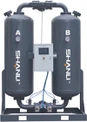
In many post-treatment equipment, the common ones are the cold dryer and the suction dryer, both of which are used to treat compressed air, but their prices vary greatly. What are the main differences between the cold dryer and the suction dryer? Next, let's talk about the three differences between the cold dryer and the suction dryer. I hope it can help you.
1. Different working principles
The working principle of the cold dryer is to use refrigerant and compressed air to expand cold exchange, reduce the temperature of compressed air, condense water molecules in the air and discharge them into liquid water. The working principle of the dryer is to use activated carbon, aluminum oxide, molecular sieve and other desiccants to conduct water molecules in the compressed air, so that the water loss in the air is more than the influence of humidity.
2. Different pressure dew points
The pressure dew point refers to the temperature at which the water in the compressed air of the two counties exceeds the saturation state, that is, the humidity. The lower the pressure dew point, the higher the humidity. The pressure dew point of the cold dryer cannot exceed 10 ° C, and the pressure dew point of the suction dryer can exceed - 20-40 ° C and can be lower than - 70 ° C. This may exceed high quality gas standards.
3. Different energy consumption
Different energy consumption is mainly reflected in gas loss. The design purpose of the cold dryer is to make the moisture in the compressed air exceed the limit, so that it can be condensed into liquid water through cooling, and the liquid water can be discharged from the machine through the automatic drainage device, so it will not cause air loss. The desiccant is because it absorbs the moisture in the compressed air. Once the moisture absorbed by the desiccant exceeds the saturation state, it must regenerate excessive hydrolysis. Therefore, 5% - 10% of regeneration gas loss is necessary.