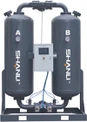
Compressed air is increasingly used in modern industry for its safety and convenience. The requirements of modern industry for high reliability and civilized production also force more and more customers to obtain pure compressed air free of oil, water and dust. Although cleaning compressed air requires energy, air dryer is a cleaning equipment with high energy consumption. Air dryers are divided into two categories: suction dryers and cold dryers. So what are the differences between a cold dryer and a suction dryer? Now let's talk about it.
1. Differences in working principles. The cold dryer is based on the principle of freezing and drying. The saturated compressed air at the inlet is cooled to a certain dew point temperature through heat exchange with the refrigerant, and a large amount of liquid water is condensed and separated by the gas-liquid separator. It is automatically discharged from the machine for dehydration and drying. The dryer is based on the principle of pressure swing adsorption. The saturated compressed air entering the inlet contacts the adsorbent under a certain pressure, most of the water is absorbed by the adsorbent, and the dry air enters the downstream for operation. To achieve the purpose of deep drying.
2. Difference in water removal effect. The refrigeration dryer is limited by its principle: if the temperature is too low, it will freeze, so the dew point temperature is usually 2~10 ℃. The dryer does not need to change the temperature, and the desiccant can be deeply dried. Therefore, the dew point temperature at the outlet can generally reach below - 20 ° C, which means that deep drying can be achieved.
3. Difference of energy loss. For the refrigeration dryer, the power supply will be more powerful because the refrigerant must be compressed for cooling. Since the dryer only needs to operate the valve through the electrical control box, the electrical power is usually only tens of watts, which means no power loss.
4. Difference of air volume loss. Since the freeze dryer performs the task of removing water by changing the temperature, and the water is discharged from the machine through the automatic drainage device, there is no air loss. However, the desiccant needs to be regenerated after water saturation, so about 6% of regeneration gas loss is required. However, the JRR series desiccant waste heat recovery dryer produced by Jiangsu Jiayu uses the waste heat generated in the air compression process to complete the regeneration of the desiccant, so it does not consume compressed air in the heating and regeneration process, but only consumes 1% of the dry compressed air in the drying process, basically reaching zero gas consumption rate.
5. Failure rate difference. As the refrigerant system and air system of the refrigeration dryer are relatively complex, including electrical components, while the dryer has only one valve, which may fail due to frequent actions, the failure rate of the dryer under normal conditions is lower than that of the dryer.