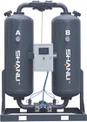
A desiccant air dryer is a device used to remove moisture from compressed air or gas. It is commonly used in industrial applications where the presence of moisture can cause damage to equipment or negatively affect the quality of the end product. The desiccant air dryer operates on the principle of adsorption, which involves the attraction and retention of moisture molecules by a solid material called a desiccant.
The desiccant used in these dryers is typically a porous material with a high affinity for water vapor, such as silica gel or activated alumina. The dryer consists of two towers filled with desiccant material. While one tower is in the drying cycle, the other tower is being regenerated.
The drying cycle begins when the moist air enters the dryer through an inlet. The air passes through a pre-filter to remove any contaminants such as dust or oil. It then enters the tower containing the dry desiccant. As the air flows through the desiccant bed, moisture molecules are attracted to the surface of the desiccant particles and adhere to them through adsorption. This process continues until the desiccant becomes saturated with moisture.
Once the desiccant bed in one tower is saturated, the drying cycle is switched to the other tower. This is accomplished using a switching valve or a controller. The tower that was in the drying cycle now enters the regeneration cycle.
During the regeneration cycle, a portion of the dried air or a separate purge air stream is diverted into the tower that needs to be regenerated. This purge air carries away the moisture from the desiccant, allowing it to release the captured water molecules. The moist air and water vapor are then exhausted from the dryer.
To ensure efficient regeneration, the purge air is typically heated to increase its capacity to carry away moisture. Some desiccant air dryers use external heaters, while others utilize internal heaters within the desiccant bed. The heating process increases the temperature of the desiccant, facilitating the release of the adsorbed moisture.
After the regeneration cycle is complete, the switching valve or controller redirects the airflow back to the previously regenerated tower, and the drying cycle recommences. This alternating cycle ensures a continuous supply of dry air.
Desiccant air dryers can achieve extremely low levels of dew point, making them suitable for applications that require dry air. They are commonly used in industries such as manufacturing, food and beverage processing, pharmaceuticals, electronics, and painting, where moisture control is critical.
In summary, a desiccant air dryer functions by using a desiccant material to adsorb moisture from compressed air or gas. The dryer operates in alternating cycles, with one tower in the drying phase while the other is being regenerated. This continuous process ensures a constant supply of dry air and prevents moisture-related issues in various industrial applications.