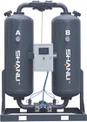
A refrigerated air dryer is a device used to remove moisture and humidity from compressed air systems. It is an essential component in various industries where dry air is critical for maintaining the efficiency and longevity of equipment and processes.
Compressed air is widely used in industrial applications for operating pneumatic tools, controlling processes, and powering machinery. However, during the compression process, the air becomes saturated with water vapor, which can lead to numerous problems if not adequately addressed. Moisture in the compressed air can cause corrosion, rust, reduced equipment performance, increased maintenance costs, and even product contamination in certain industries such as food and pharmaceuticals.
Refrigerated air dryers work on the principle of cooling the compressed air to lower its temperature, causing the moisture to condense and separate from the air. The process involves several key components, including a heat exchanger, refrigeration circuit, condensate separator, and an automatic drain.
When the compressed air enters the air dryer, it first passes through a heat exchanger. The heat exchanger cools down the air using a refrigeration circuit that consists of a compressor, condenser, expansion valve, and evaporator. The compressor pressurizes the refrigerant gas, and then it passes through the condenser where it releases heat to the surroundings. Next, the refrigerant, in a high-pressure liquid state, flows through the expansion valve, where its pressure drops, causing it to rapidly expand and cool down. The cold refrigerant then enters the evaporator, which is in direct contact with the incoming warm compressed air.
As the warm compressed air flows through the evaporator, heat transfer occurs between the air and the cold refrigerant. The air temperature decreases significantly, causing the water vapor to condense into liquid droplets. These droplets are separated from the air using a condensate separator, which typically consists of baffles or a centrifugal separator. The separated condensate is drained out of the system through an automatic drain, ensuring that only dry air continues downstream.
The cooled and dried compressed air then goes through a reheater, where it is slightly heated to prevent the formation of additional condensation in downstream pipes or equipment. Finally, the dry air is ready for use in various applications, free from moisture that could otherwise cause damage or impair performance.
Refrigerated air dryers offer several advantages. They provide a reliable and cost-effective solution for removing moisture from compressed air systems. They can achieve dew points as low as 2°C (36°F), making them suitable for most industrial applications. Refrigerated dryers are relatively simple to install, operate, and maintain compared to other types of air dryers. They have a compact design and can be integrated into existing compressed air systems without significant modifications.
However, it's important to note that refrigerated air dryers have limitations. They are not suitable for applications that require extremely low dew points, such as in certain pharmaceutical or electronics manufacturing processes. For such applications, desiccant dryers or other specialized drying methods may be necessary.
In conclusion, a refrigerated air dryer is a vital component in maintaining the quality and efficiency of compressed air systems. By effectively removing moisture from the compressed air, these dryers help prevent corrosion, equipment damage, and performance issues. With their wide range of applications and relatively simple operation, refrigerated air dryers play a crucial role in ensuring the reliability and longevity of industrial processes.