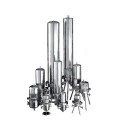
In the realm of industrial and commercial cooling systems, water chillers and cooling towers are two commonly employed technologies. As a water chiller supplier, I often encounter inquiries from customers about the differences between these two cooling solutions. This blog post aims to provide a comprehensive comparison of water chillers and cooling towers, exploring their working principles, advantages, limitations, and applications.
Working Principles
Water Chiller
A water chiller is a refrigeration system that removes heat from a process or space by circulating chilled water. The basic components of a water chiller include a compressor, condenser, evaporator, and expansion valve. The compressor compresses the refrigerant gas, raising its temperature and pressure. The high-pressure refrigerant then flows to the condenser, where it releases heat to the surrounding environment and condenses into a liquid. The liquid refrigerant then passes through the expansion valve, which reduces its pressure and temperature. The low-pressure refrigerant then enters the evaporator, where it absorbs heat from the chilled water and evaporates back into a gas. The cycle then repeats.
There are different types of water chillers, including air-cooled and water-cooled chillers. Air-cooled chillers use ambient air to cool the condenser, while water-cooled chillers use water from a cooling tower or other water source to cool the condenser. Water Cooled Water Chiller is a popular choice for applications where high cooling capacity and energy efficiency are required.
Cooling Tower
A cooling tower is a heat rejection device that removes waste heat from a process or system by transferring it to the atmosphere through the evaporation of water. The basic components of a cooling tower include a fill media, a water distribution system, a fan or blower, and a basin. The hot water from the process or system is pumped to the top of the cooling tower and distributed over the fill media. As the water flows down through the fill media, it is exposed to the air, which causes a portion of the water to evaporate. The evaporation process removes heat from the remaining water, cooling it down. The cooled water then collects in the basin at the bottom of the cooling tower and is pumped back to the process or system.
There are different types of cooling towers, including natural draft, mechanical draft, and induced draft cooling towers. Natural draft cooling towers rely on the natural buoyancy of hot air to create airflow through the tower, while mechanical draft cooling towers use fans or blowers to force air through the tower. Induced draft cooling towers use a fan or blower to draw air through the tower from the top, creating a negative pressure inside the tower.


Advantages and Limitations
Water Chiller
Advantages
- Precise Temperature Control: Water chillers can provide precise temperature control, making them suitable for applications where a constant temperature is required, such as in laboratories, data centers, and manufacturing processes.
- High Cooling Capacity: Water chillers can provide high cooling capacity, making them suitable for large-scale applications, such as in industrial plants and commercial buildings.
- Energy Efficiency: Water chillers can be energy-efficient, especially when used in conjunction with a variable speed drive or other energy-saving technologies.
- Flexibility: Water chillers can be used in a variety of applications, including process cooling, air conditioning, and refrigeration.
Limitations
- High Initial Cost: Water chillers can have a high initial cost, especially for large-scale applications.
- Maintenance Requirements: Water chillers require regular maintenance, including refrigerant charging, filter replacement, and condenser cleaning.
- Noise Pollution: Water chillers can generate noise, especially when used in close proximity to residential or commercial areas.
Cooling Tower
Advantages
- Low Initial Cost: Cooling towers can have a low initial cost, especially for small-scale applications.
- Energy Efficiency: Cooling towers can be energy-efficient, especially when used in conjunction with a variable speed drive or other energy-saving technologies.
- Environmentally Friendly: Cooling towers use water as a cooling medium, which is a renewable and environmentally friendly resource.
- Flexibility: Cooling towers can be used in a variety of applications, including industrial process cooling, power generation, and air conditioning.
Limitations
- Water Consumption: Cooling towers require a significant amount of water to operate, which can be a concern in areas with limited water resources.
- Maintenance Requirements: Cooling towers require regular maintenance, including water treatment, fill media cleaning, and fan or blower maintenance.
- Water Quality: Cooling towers can be susceptible to water quality issues, such as scaling, corrosion, and biological growth, which can affect their performance and efficiency.
- Noise Pollution: Cooling towers can generate noise, especially when used in close proximity to residential or commercial areas.
Applications
Water Chiller
- Industrial Process Cooling: Water chillers are commonly used in industrial processes, such as plastic injection molding, food and beverage processing, and chemical manufacturing, to cool equipment and processes.
- Data Centers: Water chillers are used in data centers to cool servers and other equipment, ensuring their reliable operation and preventing overheating.
- Commercial Buildings: Water chillers are used in commercial buildings, such as offices, hotels, and hospitals, to provide air conditioning and maintain a comfortable indoor environment.
- Laboratories: Water chillers are used in laboratories to cool equipment and processes, such as analytical instruments, lasers, and medical devices.
Cooling Tower
- Power Generation: Cooling towers are commonly used in power generation plants, such as coal-fired, gas-fired, and nuclear power plants, to cool the condenser and reject waste heat.
- Industrial Process Cooling: Cooling towers are used in industrial processes, such as steel manufacturing, oil refining, and chemical processing, to cool equipment and processes.
- Commercial Buildings: Cooling towers are used in commercial buildings, such as shopping malls, airports, and convention centers, to provide air conditioning and maintain a comfortable indoor environment.
- HVAC Systems: Cooling towers are used in HVAC systems to cool the condenser of a water-cooled chiller, improving the energy efficiency of the system.
Conclusion
In conclusion, water chillers and cooling towers are two different cooling technologies that have their own advantages and limitations. Water chillers are suitable for applications where precise temperature control, high cooling capacity, and energy efficiency are required, while cooling towers are suitable for applications where a low initial cost, energy efficiency, and environmental friendliness are important. As a water chiller supplier, I can provide you with a wide range of Water Chiller Unit options to meet your specific cooling needs. If you are considering a cooling system for your industrial or commercial application, I recommend consulting with a professional engineer or HVAC contractor to determine the best solution for your needs.
If you have any questions or would like to discuss your cooling requirements further, please feel free to contact me. I would be happy to assist you in selecting the right water chiller or cooling tower for your application and provide you with a competitive quote.
References
- ASHRAE Handbook of Fundamentals
- Cooling Tower Institute Standards
- Refrigeration and Air Conditioning Technology by William C. Whitman, William M. Johnson, and John Tomczyk