When it comes to water chiller units, one of the most crucial components that determine their performance and efficiency is the compressor. As a leading water chiller unit supplier, I've seen firsthand how different compressor types can significantly impact the operation of these systems. In this blog, I'll delve into the various compressor types used in water chiller units, exploring their characteristics, advantages, and applications.
Reciprocating Compressors
Reciprocating compressors are one of the oldest and most widely used compressor types in water chiller units. They operate on a simple principle: a piston moves back and forth within a cylinder, compressing the refrigerant gas. This compression process raises the pressure and temperature of the gas, which is then used to transfer heat in the refrigeration cycle.
One of the key advantages of reciprocating compressors is their high efficiency at low to medium capacities. They are also relatively simple in design, making them easy to maintain and repair. Additionally, reciprocating compressors can handle a wide range of refrigerants, which gives them flexibility in different applications.
However, reciprocating compressors also have some limitations. They tend to be noisy and have a relatively short lifespan compared to other compressor types. They also have a lower efficiency at high capacities, which makes them less suitable for large-scale water chiller units.
Reciprocating compressors are commonly used in small to medium-sized water chiller units, such as those used in commercial buildings, laboratories, and small industrial applications. They are also a popular choice for applications where the load is relatively constant and the operating conditions are not too demanding.
Rotary Compressors
Rotary compressors are another common type of compressor used in water chiller units. They operate on a rotary motion, where a rotor rotates within a cylinder to compress the refrigerant gas. There are several types of rotary compressors, including rotary vane compressors, rotary screw compressors, and scroll compressors.
Rotary vane compressors use a rotor with vanes that slide in and out of slots in the rotor to compress the gas. They are known for their compact size, quiet operation, and high efficiency at low to medium capacities. Rotary vane compressors are commonly used in small water chiller units, such as those used in residential air conditioning systems and small commercial applications.
Rotary screw compressors use two intermeshing screws to compress the gas. They are known for their high efficiency at high capacities and their ability to handle large volumes of refrigerant. Rotary screw compressors are commonly used in large water chiller units, such as those used in industrial applications and large commercial buildings.
Scroll compressors use two spiral-shaped scrolls to compress the gas. They are known for their high efficiency, quiet operation, and reliability. Scroll compressors are commonly used in medium to large-sized water chiller units, such as those used in commercial buildings, hospitals, and data centers.
Centrifugal Compressors
Centrifugal compressors are a type of dynamic compressor that uses a high-speed impeller to accelerate the refrigerant gas and then convert the kinetic energy into pressure energy. They are known for their high efficiency at high capacities and their ability to handle large volumes of refrigerant.
One of the key advantages of centrifugal compressors is their smooth and quiet operation. They also have a relatively long lifespan and require less maintenance compared to other compressor types. Additionally, centrifugal compressors can be easily controlled to match the load requirements of the water chiller unit, which makes them very energy-efficient.
However, centrifugal compressors also have some limitations. They are relatively expensive to purchase and install, and they require a large amount of space. They also have a lower efficiency at low capacities, which makes them less suitable for small-scale water chiller units.
Centrifugal compressors are commonly used in large water chiller units, such as those used in industrial applications, large commercial buildings, and district cooling systems. They are also a popular choice for applications where the load is variable and the operating conditions are demanding.
Choosing the Right Compressor Type
When choosing a compressor type for a water chiller unit, several factors need to be considered, including the capacity of the unit, the operating conditions, the load requirements, and the budget. Here are some general guidelines to help you choose the right compressor type:

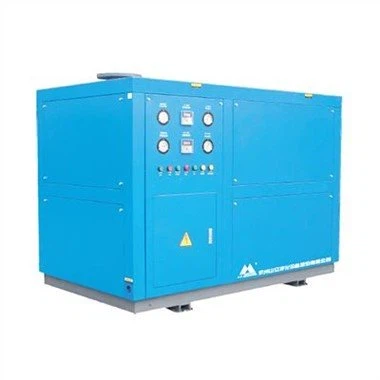
- Small to medium-sized water chiller units: For small to medium-sized water chiller units, reciprocating compressors, rotary vane compressors, and scroll compressors are good choices. They are relatively inexpensive, easy to maintain, and have a high efficiency at low to medium capacities.
- Medium to large-sized water chiller units: For medium to large-sized water chiller units, rotary screw compressors and scroll compressors are good choices. They are more efficient at high capacities and have a longer lifespan compared to reciprocating compressors.
- Large water chiller units: For large water chiller units, centrifugal compressors are the best choice. They are the most efficient at high capacities and have a smooth and quiet operation.
In addition to the compressor type, other factors such as the refrigerant type, the condenser and evaporator design, and the control system also need to be considered when choosing a water chiller unit. As a water chiller unit supplier, I can help you choose the right compressor type and the right water chiller unit for your specific application.
Conclusion
In conclusion, the compressor is a crucial component of a water chiller unit, and choosing the right compressor type is essential for ensuring the performance and efficiency of the system. Reciprocating compressors, rotary compressors, and centrifugal compressors are the most common types of compressors used in water chiller units, each with its own characteristics, advantages, and applications.
As a water chiller unit supplier, I have extensive experience in providing high-quality water chiller units with different compressor types. Whether you need a small water chiller unit for a laboratory or a large water chiller unit for an industrial application, I can help you find the right solution.
If you're interested in learning more about water chiller units or need help choosing the right compressor type for your application, please don't hesitate to contact me for a free consultation. I'm always happy to help and look forward to working with you.
References
- ASHRAE Handbook - Refrigeration. American Society of Heating, Refrigerating and Air-Conditioning Engineers.
- Refrigeration and Air Conditioning Technology. William C. Whitman, William M. Johnson, and John Tomczyk.
- Water Chiller Systems: Design, Operation, and Maintenance. John A. Duffie and William A. Beckman.