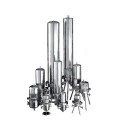
What is the drying efficiency of a modular desiccant air dryer? Well, let's dive right in and break it down.
First off, I'm a supplier of Modular Desiccant Air Dryers, so I've got some real - world experience with these things. These dryers are pretty cool pieces of equipment. They're designed to remove moisture from compressed air, and that's super important in a whole bunch of industrial applications.
Drying efficiency is all about how well the dryer can take that wet, humid air and turn it into dry air. And there are a few factors that play into this. One of the main things is the desiccant material. Most modular desiccant air dryers use materials like silica gel, activated alumina, or molecular sieves. Each of these has its own unique properties when it comes to adsorbing moisture.
Silica gel, for example, is pretty good at adsorbing water vapor. It's like a little sponge for moisture in the air. But it has its limits. If the air is really hot or really humid, silica gel might not work as well. That's where activated alumina comes in. Activated alumina can handle higher temperatures and still do a great job of adsorbing moisture. And molecular sieves are even more specialized. They can adsorb moisture at very low dew points, which is crucial in some applications where even a tiny bit of moisture can cause problems.
Another factor that affects drying efficiency is the regeneration process. There are different types of regeneration methods for modular desiccant air dryers. One common type is heatless regeneration. A Heatless Modular Desiccant Air Dryer uses a portion of the dried air to regenerate the desiccant. This is a pretty simple and reliable method, but it does use up some of the dried air in the process.
Then there's the Heatless Regeneration Modular Adsorption Dryer. It operates on the principle of pressure swing adsorption. During the adsorption phase, the wet air passes through the desiccant bed and the moisture gets adsorbed. Then, during the regeneration phase, the pressure is reduced, and the desorbed moisture is purged out of the system. This method is energy - efficient but requires careful control of the pressure and flow rates.


The drying efficiency can also be affected by the flow rate of the air through the dryer. If the air is flowing too fast, the desiccant might not have enough time to adsorb all the moisture. On the other hand, if the flow rate is too slow, the dryer might not be able to keep up with the demand. So, it's important to find the right balance.
In industrial settings, the Industrial Desiccant Air Dryer needs to be sized correctly to ensure optimal drying efficiency. This means taking into account things like the volume of compressed air, the inlet humidity, and the required outlet dew point. If the dryer is too small, it won't be able to dry the air effectively. And if it's too big, it'll be a waste of resources.
Let me give you an example. Say you've got a manufacturing plant that uses compressed air to power some precision machinery. Any moisture in the compressed air could damage the machinery or affect the quality of the products being made. So, you need a dryer that can achieve a very low dew point. In this case, a modular desiccant air dryer with a molecular sieve desiccant and a well - designed regeneration system would be ideal.
Measuring the drying efficiency of a modular desiccant air dryer is usually done by looking at the dew point. The dew point is the temperature at which the air becomes saturated with water vapor and starts to condense. A lower dew point means drier air. Most industrial applications require a dew point of - 40°F (- 40°C) or lower.
To find out the actual drying efficiency of a particular dryer, you can do some testing. You can measure the inlet and outlet dew points, as well as the humidity and temperature of the incoming and outgoing air. This data will give you a good idea of how well the dryer is performing.
Now, if you're in the market for a modular desiccant air dryer, you're probably wondering how to choose the right one for your needs. Well, it all comes down to your specific requirements. Think about the volume of compressed air you need to dry, the level of dryness you require, and your budget.
If you have any questions about our Modular Desiccant Air Dryers or need help in choosing the right one for your application, don't hesitate to reach out. We're here to assist you in finding the best solution for your drying needs. Contact us today to start the conversation about affordable and reliable modular desiccant air drying equipment.
References:
- Compressed Air and Gas Institute. Handbook of Compressed Air Systems.
- ASHRAE. Fundamentals Handbook.