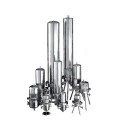
The desiccant air dryer is an essential device in many industrial applications, especially for processes that require dry air. As a heatless desiccant air dryer supplier, I've witnessed firsthand the importance of understanding the impact of desiccant particle size on the performance of these dryers. In this blog post, I'll explore how desiccant particle size affects the operation, efficiency, and overall performance of heatless desiccant air dryers.
1. Basic Principles of Heatless Desiccant Air Dryers
Before delving into the impact of desiccant particle size, it's crucial to understand the basic principles of heatless desiccant air dryers. These dryers work on the principle of adsorption, where the desiccant material adsorbs water vapor from the compressed air passing through it. Typically, a heatless desiccant air dryer consists of two towers filled with desiccant material. While one tower is in the drying mode, adsorbing moisture from the incoming air, the other tower is in the regeneration mode, where the desiccant is dried using a small portion of the dried air.
The desiccant material used in these dryers is usually a porous substance with a high affinity for water. Common desiccants include silica gel, activated alumina, and molecular sieves. The choice of desiccant depends on various factors, such as the required dew point, the operating conditions, and the type of contaminants in the air.
2. Impact on Adsorption Capacity
The adsorption capacity of a desiccant refers to the amount of water vapor it can adsorb before reaching its saturation point. Desiccant particle size plays a significant role in determining the adsorption capacity. Smaller desiccant particles have a larger surface area per unit volume compared to larger particles. This increased surface area provides more sites for water molecules to adhere to, resulting in a higher adsorption capacity.
For example, if we consider two desiccant beds of the same volume, one filled with small particles and the other with large particles, the bed with small particles will be able to adsorb more water vapor. This is because the water molecules can easily access the inner pores of the small particles, maximizing the contact area between the desiccant and the moisture in the air. As a heatless desiccant air dryer supplier, we often recommend using desiccants with smaller particle sizes for applications that require a low dew point and high moisture removal efficiency. You can learn more about our Air Compressor Line Desiccant Air Dryer which is designed to work optimally with different desiccant particle sizes.
3. Effect on Pressure Drop
Pressure drop is another important factor to consider in the operation of heatless desiccant air dryers. Pressure drop refers to the decrease in pressure as the compressed air passes through the desiccant bed. A high pressure drop can lead to increased energy consumption and reduced efficiency of the air compressor.
Desiccant particle size has a direct impact on pressure drop. Smaller desiccant particles tend to create a more tortuous path for the air to flow through the desiccant bed. This increased flow resistance results in a higher pressure drop. On the other hand, larger desiccant particles allow the air to flow more freely, leading to a lower pressure drop.
However, it's important to note that while larger particles may reduce pressure drop, they may also have a lower adsorption capacity. Therefore, a balance needs to be struck between adsorption capacity and pressure drop when selecting the desiccant particle size. At our company, we have extensive experience in optimizing the desiccant particle size to minimize pressure drop while maintaining high adsorption efficiency. Our Dessicant Dryer Desiccant Air Dryer Hot Air Dryer is engineered to achieve this balance, ensuring efficient operation and energy savings.
4. Influence on Regeneration Efficiency
Regeneration efficiency is crucial for the continuous operation of heatless desiccant air dryers. During the regeneration process, the desiccant needs to be dried to restore its adsorption capacity. The desiccant particle size can affect the regeneration efficiency in several ways.
Smaller desiccant particles have a shorter diffusion path for the water molecules to escape during regeneration. This means that the water can be removed more quickly from the desiccant, resulting in a faster regeneration process. Additionally, the larger surface area of small particles allows for better contact with the regeneration air, enhancing the heat and mass transfer during regeneration.
Larger desiccant particles, on the other hand, may require a longer regeneration time due to the longer diffusion path for the water molecules. However, they may also be more resistant to attrition during the regeneration process, which can be beneficial in some applications.
As a supplier, we understand the importance of optimizing the desiccant particle size for efficient regeneration. Our Asme Desiccant Air Dryer is designed to ensure effective regeneration, regardless of the desiccant particle size used.
5. Impact on Desiccant Lifespan
The lifespan of the desiccant is an important consideration for the long - term operation and cost - effectiveness of heatless desiccant air dryers. Desiccant particle size can influence the desiccant lifespan in multiple ways.


Smaller desiccant particles are more prone to attrition, which is the wearing away of the desiccant material due to friction and impact. As the desiccant particles collide with each other and with the walls of the dryer tower during the adsorption and regeneration cycles, smaller particles can break down into finer dust. This dust can then be carried out of the dryer with the compressed air, leading to a loss of desiccant material and potentially causing damage to downstream equipment.
Larger desiccant particles are generally more resistant to attrition, resulting in a longer desiccant lifespan. However, as mentioned earlier, larger particles may have a lower adsorption capacity and regeneration efficiency. Therefore, the choice of desiccant particle size needs to take into account the trade - off between desiccant lifespan and performance.
6. Considerations for Different Applications
The optimal desiccant particle size can vary depending on the specific application. For applications that require a very low dew point, such as in the electronics or pharmaceutical industries, smaller desiccant particles may be preferred due to their higher adsorption capacity. However, in applications where energy efficiency and low pressure drop are more important, such as in some general industrial processes, larger desiccant particles may be a better choice.
As a heatless desiccant air dryer supplier, we work closely with our customers to understand their specific requirements and recommend the most suitable desiccant particle size for their applications. Whether you need a dryer for a high - precision manufacturing process or a large - scale industrial operation, we have the expertise and products to meet your needs.
7. Conclusion and Call to Action
In conclusion, desiccant particle size has a significant impact on the performance, efficiency, and lifespan of heatless desiccant air dryers. The choice of desiccant particle size needs to be carefully considered based on factors such as adsorption capacity, pressure drop, regeneration efficiency, and desiccant lifespan.
If you're in the market for a heatless desiccant air dryer or need advice on optimizing the desiccant particle size for your existing dryer, we're here to help. Our team of experts has years of experience in the industry and can provide you with tailored solutions to meet your specific requirements. Contact us today to start a discussion about your air drying needs and explore how our products can enhance your operations.
References
- Perry, R. H., & Green, D. W. (Eds.). (2008). Perry's Chemical Engineers' Handbook. McGraw - Hill.
- Kohl, A. L., & Nielsen, R. B. (1997). Gas Purification. Gulf Publishing Company.
- Struckmann, S., & Koopmann, A. (2001). Adsorption technology and design. Wiley - VCH.